
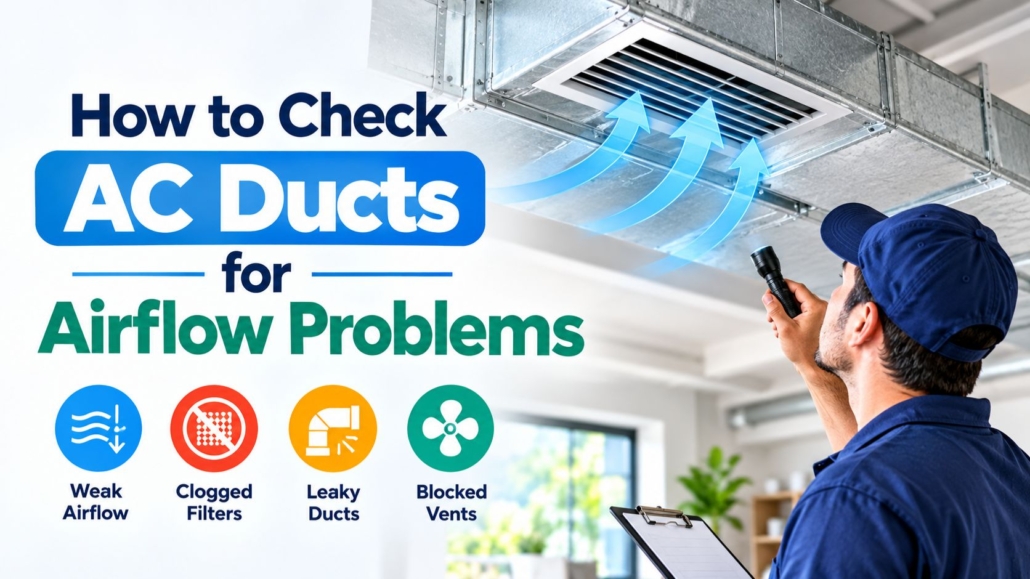
How to Check AC Ducts for Airflow Problems
Proper duct airflow is important for an AC system to cool a building evenly. Ducts carry conditioned air from the indoor air handler to individual rooms and return air to the HVAC system. When ducts are blocked, disconnected, leaking, crushed, or poorly designed, some rooms may receive less cool air than others.
Airflow problems can also make an AC operate for longer periods. This can affect comfort and may increase energy consumption. A basic inspection can identify visible duct problems, while professional testing can measure airflow and locate hidden restrictions or leaks.
What Are AC Ducts?
AC ducts are passages that transport conditioned air throughout a building. A typical central HVAC system has supply ducts and return ducts.
Supply ducts carry cooled air from the indoor unit to rooms. Return ducts move indoor air back toward the air handler. Both sides of the system need adequate airflow for proper operation.
Ducts can be made from materials such as sheet metal, fiberglass duct board, or flexible insulated duct. The design depends on the building, HVAC equipment, available space, and installation requirements.
What Causes AC Duct Airflow Problems?
Duct airflow problems can develop for several reasons. A flexible duct may become compressed or kinked. A connection can become loose or disconnected. Leaks can also allow conditioned air to escape before it reaches the intended room.
Dust and debris can restrict airflow in some systems. Closed dampers, blocked registers, poorly designed duct branches, and insufficient return airflow can also create temperature differences.
The blower, filter, evaporator coil, and other HVAC components can affect airflow as well. Therefore, checking the ducts alone may not identify every airflow problem.
Check the AC Supply Vents
Start by checking the supply vents in each room. Make sure the registers are open and not blocked by furniture, curtains, rugs, or other objects.
Place your hand near the vent while the AC is operating. Compare the airflow between rooms. A major difference can indicate a possible duct or system airflow problem.
This basic check does not measure airflow accurately. Professional HVAC technicians can use instruments to measure airflow and determine whether the system is delivering the required volume of conditioned air.
Check the Return Air Vents
Return vents are just as important as supply vents. They allow indoor air to travel back to the air handler.
A blocked return grille can restrict circulation. Furniture, curtains, storage items, and dust can reduce the open area around the grille.
Keep return-air openings clear. If a room becomes significantly warmer when its door is closed, the return-air path may need evaluation.
Inspect Accessible Flexible Ducts
Flexible ducts are common in residential HVAC systems. They contain an inner air passage surrounded by insulation and an outer protective layer.
Look for visible kinks, crushing, sagging, disconnected sections, or damaged insulation. A severely compressed flexible duct can reduce the amount of air that reaches a room.
Do not pull, cut, or reposition ductwork without understanding how the system is designed. Incorrect changes can create new airflow restrictions or cause connections to separate.
Look for Disconnected Ducts
A disconnected duct can release conditioned air into an attic, crawlspace, ceiling cavity, or other unintended area.
A room may receive very little airflow when its supply duct becomes disconnected. You may also notice unusual airflow or cooling in an area where conditioned air should not be released.
Accessible connections can be visually inspected. Hidden duct connections may require professional inspection.
Check for Duct Leaks
Duct leakage allows conditioned air to escape before reaching the intended room. The effect can be greater when ducts pass through unconditioned spaces such as attics or crawlspaces.
Visible gaps, damaged connections, and deteriorated sealing materials can indicate possible leakage. However, small leaks may not be visible during a basic inspection.
Professional duct testing can identify leakage more accurately. Depending on the system, technicians may use pressure testing and other diagnostic methods to evaluate duct performance.
Check Duct Insulation
Duct insulation helps reduce unwanted heat transfer. This is especially important when supply ducts pass through hot attics, garages, crawlspaces, or other unconditioned spaces.
Damaged, compressed, or missing insulation can allow conditioned air to gain heat before reaching a room.
Inspect accessible duct insulation for tears, gaps, moisture damage, and compression. Damaged insulation may need repair or replacement depending on its condition and location.
Check AC Dampers
Some duct systems use dampers to control airflow between different branches. A damper that is partially closed can reduce airflow to the connected rooms.
Check accessible dampers only when their operation and intended position are clearly understood. Incorrect damper adjustments can reduce airflow in other parts of the building.
An HVAC technician can balance the duct system using airflow measurements rather than adjusting dampers based only on how a room feels.
Check for Dirty AC Filters
A dirty air filter can reduce the amount of air moving through the HVAC system. This can affect airflow at multiple supply vents.
Check the filter according to the manufacturer’s recommendations. Replace a disposable filter or clean a reusable filter when required.
Filter size is also important. A filter should fit correctly and provide the filtration level specified for the equipment.
If airflow remains weak after filter maintenance, the problem may involve the blower, evaporator coil, ductwork, or another component.
Check the AC Evaporator Coil
A dirty evaporator coil can restrict airflow through the indoor unit. Dust and debris can collect between the coil fins and reduce the available air passage.
A restricted coil can also affect heat transfer and cooling performance. In some cases, severe airflow restriction can contribute to coil freezing.
Coil inspection and cleaning should be performed carefully. The fins can bend easily, and some evaporator coils are installed inside sealed equipment cabinets.
Check the AC Blower
The indoor blower moves air through the HVAC system. Problems with the blower motor, blower wheel, electrical controls, or other components can reduce airflow.
If airflow is weak from most supply vents, the problem may not be limited to one duct branch. A system-wide airflow problem can point toward the filter, blower, evaporator coil, return-air system, or another central component.
Electrical and internal blower components should be inspected by a qualified HVAC professional.
How to Identify a Duct Airflow Problem
One of the simplest signs is a noticeable temperature difference between rooms. A room may remain warm while nearby rooms receive normal cooling.
Other signs include weak airflow from one or more vents, unusual whistling or hissing sounds, longer cooling cycles, rooms that cool slowly, or excessive dust around certain registers.
These symptoms can have multiple causes. A complete HVAC assessment is needed to distinguish duct problems from equipment, insulation, thermostat, or refrigeration issues.
Can Duct Problems Make an AC Run Longer?
Yes. Restricted or leaking ducts can reduce the amount of conditioned air reaching the intended space. The thermostat may continue calling for cooling when the target area has not reached the desired temperature.
Longer operating cycles can increase energy use. The actual effect depends on the severity of the duct problem, outdoor conditions, system capacity, building insulation, and other factors.
Correcting significant duct restrictions and leaks can improve air distribution when the ductwork is the source of the problem.
How Professionals Test AC Duct Airflow
A professional HVAC inspection can provide more accurate information than a hand test at the vent.
Technicians may measure supply-air and return-air conditions, airflow volume, static pressure, temperature differences, and other operating values. They can also inspect accessible duct sections and identify restrictions or leakage.
The appropriate measurements depend on the HVAC equipment and duct design. The results can help determine whether the problem is located at the ductwork, blower, filter, evaporator coil, return system, or another component.
When Should You Call an HVAC Professional?
Professional HVAC service is recommended when airflow remains weak after checking the filter and vents. It is also appropriate when one or more rooms consistently receive little conditioned air.
Professional inspection is especially important when ducts are located inside walls, ceilings, attics, or crawlspaces and cannot be safely accessed.
A technician can inspect the complete airflow path and determine whether duct sealing, duct repair, insulation work, airflow balancing, or equipment service is required.
AEO: Quick Answer to Checking AC Ducts
How do I check my AC ducts for airflow problems?
Start by checking that supply and return vents are open and unobstructed. Inspect accessible ductwork for visible kinks, disconnected sections, crushed areas, damaged insulation, and obvious gaps. Check the air filter as well. Compare airflow between rooms while the system is operating. If airflow remains weak or uneven, an HVAC professional can perform airflow and duct testing.
How can I tell if my AC duct is leaking?
Visible gaps, disconnected joints, damaged insulation, and unusual airflow around accessible duct connections can indicate leakage. However, hidden leaks cannot always be identified visually. Professional duct testing can provide a more accurate assessment.
What is normal AC airflow?
There is no single airflow value that applies to every HVAC system. Required airflow depends on equipment capacity, duct design, static pressure, and manufacturer specifications. A professional technician can measure actual airflow and compare it with the system’s requirements.
GEO: Local AC Duct Inspection and Repair
People searching for AC duct repair near me, AC service near me, or HVAC technician near me may have uneven cooling, weak airflow, or rooms that remain warm.
A local HVAC professional can inspect supply ducts, return ducts, dampers, registers, insulation, filters, blower components, and other parts that affect air distribution.
For local HVAC service, a location-specific page should clearly state the service area, duct inspection and repair services, AC maintenance options, common airflow problems, HVAC system types supported, and contact information. This information provides geographic context for local search and AI-generated answers.
Frequently Asked Questions
Why is the AC airflow weak in one room?
Possible causes include a restricted or disconnected duct, closed damper, blocked register, duct leakage, poor insulation, or an airflow imbalance. The exact cause requires inspection.
Can a closed door affect AC airflow?
Yes. A closed room door can restrict the return-air path when the room does not have an adequate return vent or transfer-air path. This can affect air circulation.
Can furniture block AC airflow?
Yes. Furniture, curtains, rugs, and other objects can block supply or return vents. Keeping vents clear allows air to move through the intended openings.
Should I seal AC ducts myself?
Small accessible duct connections may have specific sealing requirements, but duct systems should be evaluated before repairs are made. Improper sealing materials or installation can create additional problems.
Can ductwork cause uneven cooling?
Yes. Leaks, restrictions, disconnected sections, crushed flexible ducts, poor insulation, and airflow imbalance can cause some rooms to receive less conditioned air.
How often should AC ducts be inspected?
Inspection frequency depends on the building, duct type, indoor conditions, HVAC usage, and system history. Ductwork should also be checked when persistent airflow or temperature problems occur.
Conclusion
Checking AC ducts can help identify common airflow problems such as visible leaks, disconnected sections, crushed flexible ducts, blocked registers, damaged insulation, and incorrect damper positions. Supply and return airflow should be considered together because both are important for proper air circulation.
A basic inspection can identify visible problems, but it cannot measure airflow accurately or detect every hidden duct leak. Professional HVAC testing can evaluate airflow, static pressure, duct leakage, equipment performance, and temperature differences.
